



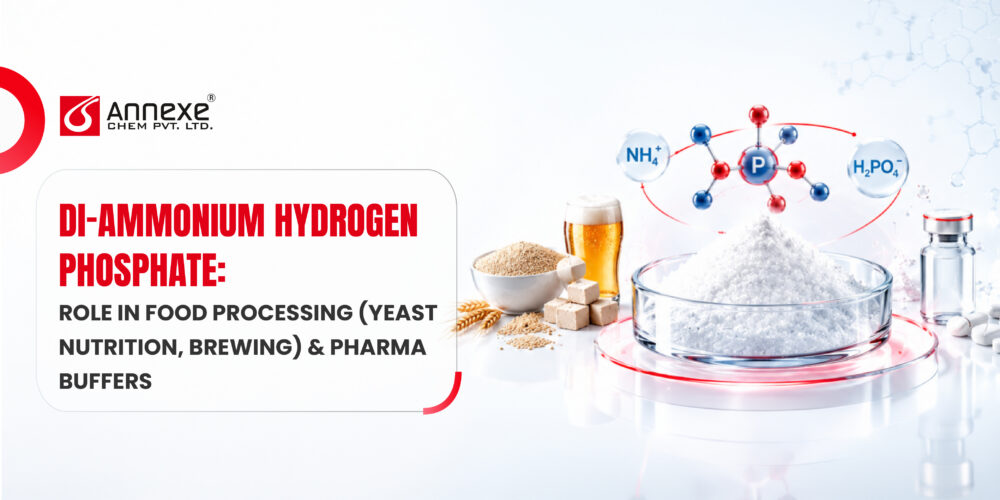
What do food processing, brewing, and pharmaceutical formulations have in common? The answer may be a compound you rarely notice, but one that plays an important role behind the scenes: Di-ammonium Hydrogen Phosphate (DAP).
From supporting yeast during fermentation to contributing phosphate ions for buffer systems, DAP offers functional properties that make it valuable across diverse manufacturing processes. But what exactly makes it so useful, and how does its role change from one industry to another?
Let’s explore how this versatile phosphate compound supports food processing, yeast nutrition, brewing, and pharmaceutical applications.
What Is Di-ammonium Hydrogen Phosphate?
A common commercial term for Diammonium Phosphate, it is a salt made up of di-ammonium and phosphate and has a chemical formula as (NH₄)₂HPO₄. Highly soluble in water, a fact which enables it to be an excellent source of ammonium nitrogen (N) and phosphate (PO₄). For that reason, it can be very useful whenever controlled feeding of nutrients or phosphate-based chemistry is a requirement.
The properties that Diammonium Phosphate has, which are chemical in nature, as well as its ability to buffer the pH of a solution, make its application in different fields highly versatile. Different applications of Diammonium Phosphate are dictated by its purity and grade. It’s a multifaceted ingredient that can be used in food processing, fermentation and brewing, lab experiments, and drug manufacturing as well. When handling critical applications where safety is a top concern, one of the key features is to source a grade that complies with quality and regulatory requirements.
Role of Di-ammonium Hydrogen Phosphate in Food Processing
Food processing often depends on carefully controlled ingredients to maintain product consistency, processing stability, and desired quality. DAP is one such phosphate compound that can provide both ammonium nitrogen and phosphate functionality, depending on the specific formulation and application.
Nutritional and Functional Properties: DAP contains ammonium ions and phosphate ions, giving it a dual functional role in suitable food-processing applications. Its water solubility enables its incorporation into aqueous formulations and processing systems where these components are required. Key properties that make DAP relevant to food processing include:
- Provides ammonium nitrogen: Can serve as a nitrogen source in specific food and fermentation-related processes.
- Provides phosphate: Contributes phosphate ions that can support particular formulation and processing requirements.
- High water solubility: Allows for relatively easy incorporation into suitable liquid systems.
- Consistent composition: Food-grade DAP can provide controlled and predictable ingredient performance when manufactured to appropriate specifications.
Supporting pH Control: One of the important characteristics of phosphate compounds is their ability to participate in buffer systems. In food processing, maintaining the appropriate pH can be important for controlling product characteristics and ensuring process consistency. DAP can contribute phosphate species to formulations where phosphate-based pH control is appropriate. Depending on the overall formulation, phosphate systems may help:
- Maintain a more stable pH during processing
- Reduce undesirable changes caused by acidic or alkaline ingredients
- Support consistency between production batches
- Create processing conditions suitable for specific food formulations
However, the effectiveness of a buffer system depends on the complete formulation, concentration, temperature, and target pH; not simply on the presence of DAP.
Applications in Food Processing: The role of DAP varies depending on the food product and manufacturing process. Rather than serving one universal function, it may be selected for its nutritional or phosphate-related properties in specific applications. Potential areas of relevance include:
- Fermentation-related food processing: Where microorganisms are involved, nitrogen availability can influence microbial growth and metabolic activity. DAP can provide ammonium nitrogen in suitable fermentation systems.
- Formulation support: Phosphate compounds can be incorporated into certain food formulations to provide specific functional properties. The exact purpose depends on the product’s composition and processing requirements.
- pH and process control: Where phosphate-based buffering is appropriate, DAP can contribute to maintaining controlled chemical conditions during processing.
Diammonium Hydrogen Phosphate in Yeast Nutrition
Yeast needs the right balance of nutrients to grow, remain active, and carry out efficient fermentation. DAP can serve as a useful source of assimilable nitrogen and phosphate, particularly in fermentation processes where naturally available nutrients may be limited. Nitrogen is essential for yeast growth and metabolism. When nitrogen availability is insufficient, yeast activity may slow, potentially affecting fermentation performance and consistency. DAP supplies ammonium nitrogen that yeast can readily utilize under suitable fermentation conditions. Key benefits of DAP in yeast nutrition include:
- Supports healthy yeast growth and activity
- Provides an accessible nitrogen source
- Helps maintain consistent fermentation conditions
- Supplies phosphate required for cellular functions
- Can complement naturally available nutrients in fermentation media
The appropriate quantity depends on the yeast strain, fermentation medium, nutrient profile, and process conditions. Therefore, DAP should be used according to the specific requirements of the fermentation process.
Use of Di-ammonium Hydrogen Phosphate in Brewing
In brewing, yeast nutrient management can directly influence fermentation performance and consistency. DAP may be used to supplement nitrogen when the available nutrient content of the brewing medium is inadequate. By providing ammonium nitrogen, DAP can support yeast activity during fermentation and help create more consistent fermentation conditions. However, nutrient requirements vary between brewing processes, so dosage and timing should be carefully controlled.
For brewers, the key is not simply adding more nutrients, but providing the right nutrient balance at the right stage of fermentation.
Di-ammonium Hydrogen Phosphate as a Pharmaceutical Buffer Component
In pharmaceutical manufacturing, pH control is more than a formulation detail; it can directly influence the stability, solubility, and performance of a product. Buffer systems are therefore used to maintain a controlled pH when formulations are exposed to small amounts of acidic or alkaline substances. DAP can contribute phosphate species to suitable buffer systems, making it relevant to certain pharmaceutical and laboratory formulations where phosphate-based pH control is required.
Understanding Pharmaceutical Buffer Systems: A pharmaceutical buffer is generally a combination of a weak acid and its corresponding conjugate base. Together, these components help resist significant changes in pH when small quantities of acids or bases are introduced. Maintaining the desired pH can be important because changes in acidity or alkalinity may affect:
- Chemical stability of active pharmaceutical ingredients
- Solubility of formulation components
- Product shelf life
- Compatibility between ingredients
- Performance and consistency of the final formulation
The choice of buffer depends on the target pH, formulation composition, concentration, and intended route of administration.
Role of Phosphate-Based Buffers: Phosphate systems are widely used in pharmaceutical and laboratory settings because they offer useful buffering capacity across a relevant pH range and can be formulated using different phosphate salts. DAP contributes the hydrogen phosphate ion (HPO₄²⁻) to a solution. When combined with an appropriate phosphate counterpart, it can form part of a phosphate buffer system designed to maintain a specific pH. Its role may include:
- Providing phosphate ions to the formulation
- Supporting controlled pH conditions
- Contributing to buffer capacity
- Helping maintain formulation consistency during processing and storage
Nevertheless, DAP isn’t necessarily the right choice for each pharmaceutical buffer. The buffer composition has to be determined keeping in mind the pH level that’s needed, concentration, ionic strength, compatibility, and formulation features.
Annexe Chem, an industry leader in the manufacture of Di-ammonium hydrogen phosphate, ensures the production of premium-grade DAP to satisfy the needs of challenging industrial segments. Through high-quality standards for production consistency, Annexe Chem supplies reliable Di-ammonium Hydrogen Phosphate for food processing, brewing, yeast nutrition, and pharmaceutical applications.
Quality-oriented cooperation is a must for manufacturers needing a trusted DAP manufacturer and supplier so that product development can be supported by consistent, reliable production, and customers will be confident from the raw material to the finished product.
Looking for High-Quality Di-Ammonium Hydrogen Phosphate?
Partner with Annexe Chem for consistent, high-purity DAP tailored to your food, brewing, fermentation, and pharmaceutical requirements. Talk to our experts today to discuss your requirements.

Disodium Hydrogen Phosphate Monohydrate: Uses in.
You may not notice it, but phosphate compounds play a quiet role in many of the.

Calcium Gluconate: Injectable Formulations & Calcium-Fortified.
Calcium plays a vital role in everything from strong bones and teeth to normal muscle and.